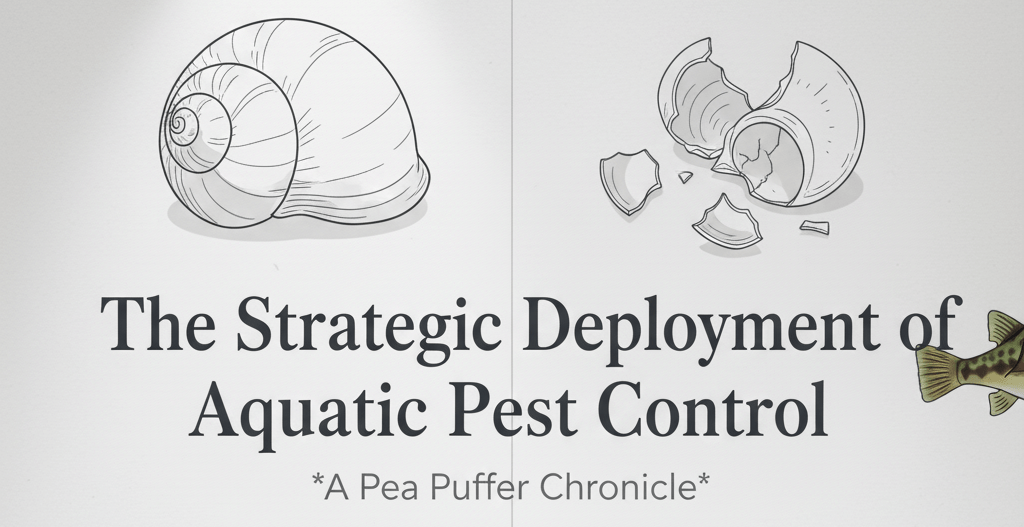
The aquatic hobby, like any pursuit bordering on obsession, eventually requires a reckoning with pests. For the seasoned aquarist, this reckoning often manifests as a slow, inexorable invasion of the unwanted snail. They arrive in clandestine fashion, tiny stowaways clinging to the leaves of new Anubias or nestled deep within the substrate. Within weeks, the population density reaches a comical tipping point, transforming a carefully curated waterscape into a molluscan housing crisis. One could, of course, resort to chemicals, but that is the intellectual equivalent of bombing the capital to deal with a few unruly citizens. No, this infestation required an elegantly tailored solution—a predator whose diet was specific, whose efficiency was unmatched, and whose adorability was, quite frankly, a brilliant piece of biological camouflage.
I confess, I did not acquire my pea puffers, those impossibly small, perpetually perturbed creatures, by accident. I was not a naive beginner who stumbled upon them at the local fish store, unaware of their carnivorous mandate. Far from it. I sought them out with the cold, clear focus of a military strategist selecting a highly specialized commando unit. I knew precisely what the Carinotetraodon travancoricus was: a molluscicidal engine encased in a tiny, spotted body. The snails were not a tragedy; they were fodder. They were the necessary, teeming food source for the charmingly aggressive contract killers I was about to introduce.
The introduction of the first three puffers—named, with intellectual gravity, Archimedes, Cleopatra, and Tiny Destroyer—was a quiet affair. They hovered near the bottom, their eyes swiveling independently, giving them the look of miniature, highly suspicious academics. The initial phase was one of calculated observation; the puffers, discerning diners that they are, seemed to conduct a census, perhaps rating the nutritional viability of the vast, oblivious snail population. The common ramshorn and bladder snails, having evolved to endure chemicals and starvation, were entirely unprepared for a foe that preferred to dismantle them with a precision strike rather than a messy ambush.
The ensuing weeks offered a gruesome, yet fascinating, study in natural selection. There was no widespread massacre; the puffers are too dignified for that. Instead, it was a methodical, almost surgical reduction of the mollusc population. They would stalk a snail, deliver a swift, decisive nip to the operculum, and extract the soft tissues with the clean efficiency of a diner shucking an oyster. The empty shells were left scattered across the gravel floor, evidence of a job expertly done—a tiny, shelled graveyard that served as both trophy and deterrent. It was a vicious cycle, but one I had knowingly orchestrated.
Today, the aquarium is a picture of serene balance. The snails are a rarity in my other tanks, their numbers maintained at a sustainable, easily consumable level, ensuring my puffers are perpetually employed and their health remains robust. And I, the omniscient narrator and architect of this balanced brutality, simply offer a knowing nod to Archimedes, the most efficient of the group. It’s a small reminder that sometimes, the most intelligent and effective solution to a pest problem is to simply sign a pact with a tiny, finned devil and appreciate the elegant, violent beauty of nature’s design.
 Frequently Wrong, Rarely in Doubt
Leave a comment